Simple blind problems are often easy to fix yourself with a few checks and tweaks. This article walks through practical, low‑risk steps for the most common issues, and flags when it is safer to call a professional.
Before you start: safety first
Always check how your blinds are mounted and how the cords or chains are routed. If anything looks loose, cracked or unstable, avoid forcing it and consider getting it inspected. Never dismantle spring mechanisms, motor units or tensioned systems unless you are trained, as these can release stored energy suddenly. For any blinds fitted in children’s rooms, always keep cords and chains secured using safety cleats or tension devices.
Problem 1: The roller blind won’t roll up or down
This usually comes down to the mechanism, fabric alignment or something obstructing the tube.
Simple checks:
- Check for obstructions: Make sure nothing is caught in the fabric, at the side brackets or on the window sill that could be blocking movement.
- Test the chain: If the control chain slips but the tube barely moves, the clutch may be worn or the chain may be off its sprocket; sometimes gently reseating the chain into the teeth of the mechanism helps.
- Straighten the fabric: If the blind rolls up at an angle and bunches on one side, pull it fully down, then roll it up by hand, applying light side‑pressure to guide the fabric back into a straight roll.
If it still won’t budge:
- Remove the blind from the brackets (usually by lifting and tilting the pin‑end first) and check the ends of the tube for broken pins or damaged plastic.
- If the internal spring or clutch is broken, replacement parts or a new headrail are usually required; at this point, it is often more cost‑effective and safer to ask a professional to repair or replace the blind.
Problem 2: Roller blind springs up too fast
Spring‑loaded roller blinds can lose tension or become over‑tightened.
Try this:
- Fully lower the blind: Pull it down to its maximum drop so there is minimal spring tension.
- Remove the blind from its brackets: Keep a firm grip so it does not snap back.
- Adjust the tension: On many spring rollers, you can gently rotate the tube by hand a turn or two in the desired direction to add or release tension, then re‑hook into the brackets and test.
If the blind still snaps up violently or refuses to stay at the height you set, the spring may be worn out and should be replaced rather than repeatedly rewound.
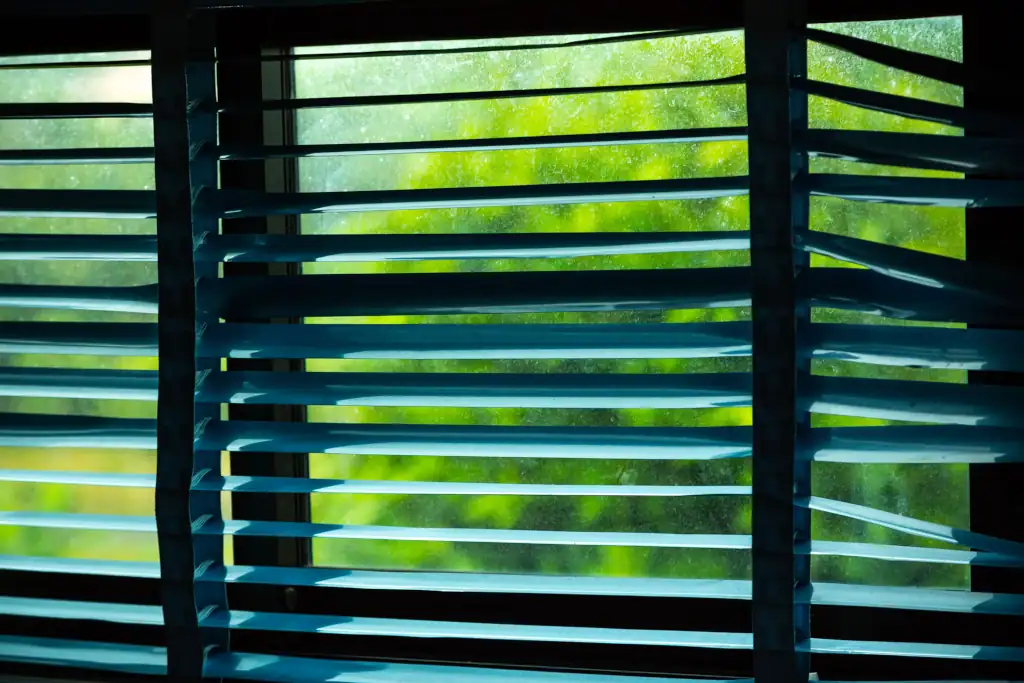
Problem 3: Slats are misaligned on Venetian blinds
Crooked or uneven slats are usually caused by tangled lift cords or one side raising higher than the other.
Quick fixes:
- Fully raise and lower the blind: Sometimes running it all the way up and down slowly will allow the cords to settle and realign the slats.
- Level the bottom rail: With the blind lowered, gently pull down on the higher side of the bottom rail to encourage the cords on that side to extend and even up.
- Check ladder cords: Make sure the “ladder” tapes or cords that hold the slats are not twisted or caught on the headrail or brackets.
If one side still sits higher:
- Inspect the headrail: Remove the blind, look at the cord spools inside and check whether one cord is wrapped more times than the other.
- Carefully unwind or adjust the extra wraps so both sides are balanced, then rehang and test.
Problem 4: Vertical blind slats not turning or sliding smoothly
When vertical blinds do not tilt or do not all move together, the carriers or hooks in the headrail often need attention.
Steps to try:
- Inspect the slat hooks: Make sure each fabric or PVC vane is properly clipped into its hanger and not twisted around.
- Reset the mechanism: Fully rotate the blind from one tilt extreme to the other using the chain or wand; this can sometimes re‑sync the carriers.
- Clean the track: Dust and debris in the headrail can make carriers stick; use a soft brush or vacuum with a brush attachment to clean it.
If one carrier is stuck:
- Gently nudge it along the track with your hand; do not force it if there is strong resistance, as this suggests a broken carrier or gear that may need replacing.
Problem 5: Tangled or knotted cords
Tangled lift cords are annoying but often simple to fix if you stay patient.
Untangling process:
- Lower the blind fully: This gives maximum slack and makes knots easier to see.
- Separate strands: Work from the bottom up, gently teasing apart each cord rather than pulling hard on the knot.
- Check cord path: Make sure cords run correctly through the cord lock and any pulleys, with no twists around each other.
Preventing future tangles:
- Use the cleat or tension device: Wind excess cord neatly when the blind is raised.
- Raise and lower in a straight, controlled motion rather than jerking the cord.
If the cords are badly frayed or the internal cord routing is damaged, it is safer to have them re‑corded or the blind replaced, especially on older wooden or aluminium Venetians.
Problem 6: Blind is stuck halfway
A blind that stops halfway may be catching on an obstacle or hitting a worn part in the mechanism.
Check:
- For obstructions: Look for objects on the sill, window handles or nearby hardware that could be catching the fabric or slats.
- For twisted components: With Venetian or vertical blinds, a twisted slat or vane can jam the movement; straighten or rehang the affected piece.
If the mechanism clicks but the blind will not move further, the internal lock or clutch may be damaged; this usually calls for repair or replacement rather than forcing it and risking a full break.
When to stop and call a professional
DIY fixes are fine for superficial issues like minor misalignment, light tangles and dirt in the track. You should stop and get professional help if:
- The blind is very heavy, installed high up or over stairs.
- You suspect damage to springs, clutches, motors or tensioned systems.
- The headrail or brackets are loose from the wall or reveal cracks in the fixings.
- There are child safety devices that you do not fully understand how to refit correctly.
A specialist like Galaxy Blinds can quickly diagnose whether repair or replacement is the best option and ensure everything is refitted safely, especially in busy family homes.